
National
Bahamas Project for Marine Conservation Hits Major Milestone in MPA Assessments
NASSAU, BAHAMAS – The Bahamas Project for Marine Conservation (BPMC) held its second week-long Management Effectiveness Tracking Tool (METT) Workshop with project partners and environmental stakeholders, surpassing the midway point in its assessment of 70 Marine Protected Areas (MPAs) across the country.

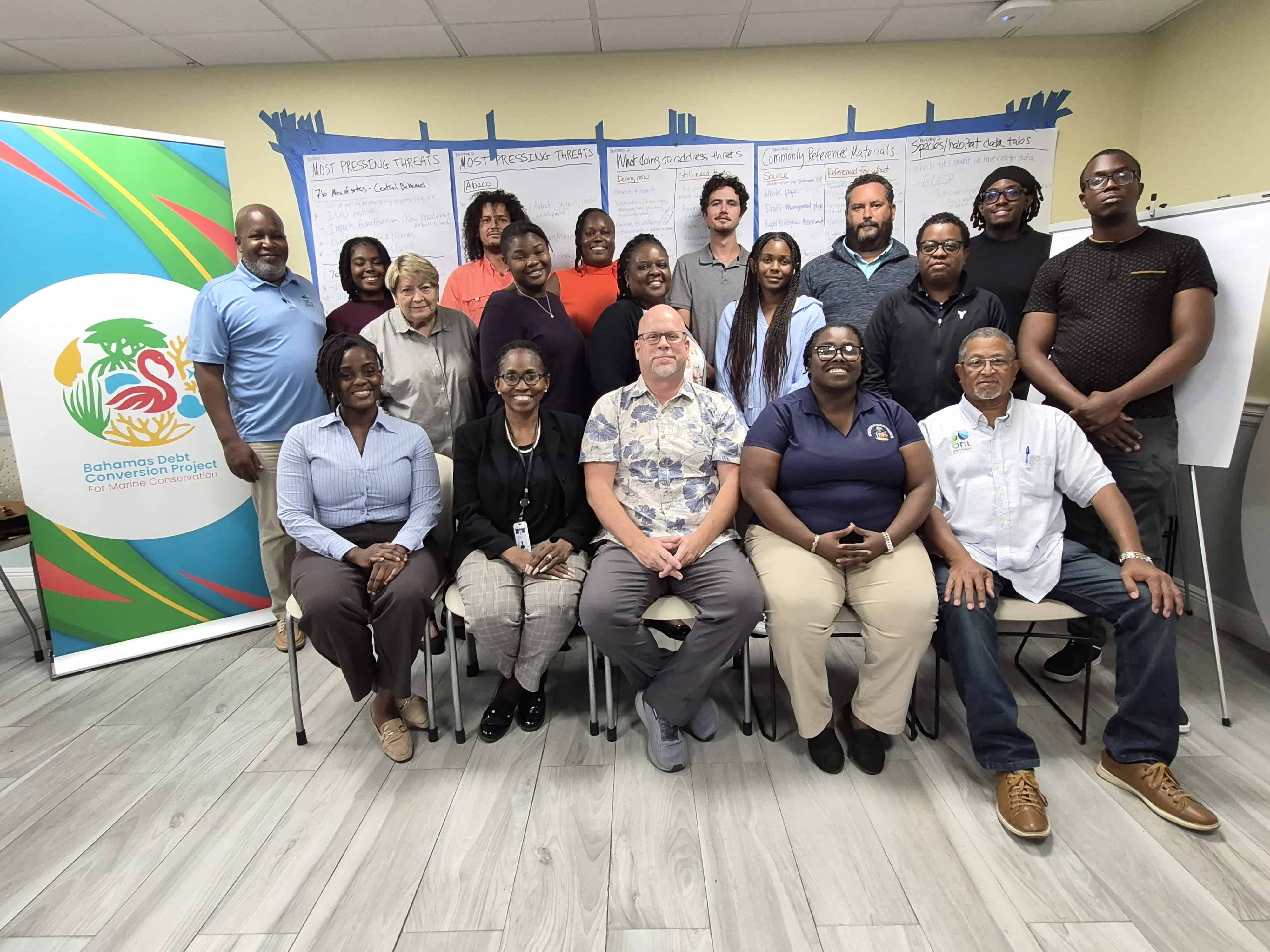
NASSAU, BAHAMAS – The Bahamas Project for Marine Conservation (BPMC) held its second week-long Management Effectiveness Tracking Tool (METT) Workshop with project partners and environmental stakeholders, surpassing the midway point in its assessment of 70 Marine Protected Areas (MPAs) across the country.
The BPMC, also known as the Bahamas Debt Conversion Project for Marine Conservation
(BDCPMC), is an innovative 15-year initiative. By leveraging savings from The Bahamas’
external debt, the project provides dedicated funding to support MPAs, biodiversity, sustainable livelihoods, and the long-term resilience of the country’s marine and coastal ecosystems.
The BPMC is a national project headed by the Project Management Unit (PMU) in the Office of
the Prime Minister. This 15-year project refinances USD 300 million in savings from The
Bahamas’ external debt, generating USD 124 million in dedicated funding for ocean
conservation and improved management of the country’s 70 MPAs. The sites were grouped into three tiers for the assessment process, ranging from Tier 1 (highly evolved with established management) to Tier 3 (unassigned areas with emerging management needs and limited information).
The first METT Workshop was held this June. Project partners from the Bahamas Forestry Unit, Department of Marine Resources, Department of Environmental Planning and Protection,
Bahamas National Trust, and the Bahamas Protected Areas Fund, their specialists and
on-the-ground experts, convened in the capital at the Office of the Prime Minister to evaluate the 27 Tier 1 and Tier 2 MPAs.
Following a successful initial workshop, the second workshop expanded participation to include a broader cross-section of stakeholders. In addition to project partners, virtual attendees included representatives from the Bahamas Marine Mammal Research Organization (BMMRO), Earth Care, Cape Eleuthera Island Institute, Island School, Department of Local Government, Green Climate Fund, Bahamas Agriculture & Marine Science Institute (BAMSI), and The Nature Conservancy. These conservationists, community organizations, government agencies, environmental NGOs, and research institutes shared their experiences and insights, weighing in on how best the protected area sites can be improved and managed.
This group of participants collectively completed the assessment for an additional 23 MPAs,
bringing the national total to 50 MPAs assessed in under 6 months. This high-level collaboration encouraged partners to share their local knowledge, management experiences, and technical expertise, ensuring that each assessment reflected the true realities of individual protected areas across the islands. Leading the event, PMU Monitoring & Evaluation Consultant, Jacklyn Chisholm-Lightbourne, explained that for the METT assessments, the group has been consistently evaluating challenges, threats, and other components of each site to complete assessment worksheets for accurate data collection.
“The workshop has demonstrated that there is value in bringing diverse stakeholders with
different areas of expertise together.The stakeholder engagement session provided an
opportunity for environmental stakeholders to bring their insight and experience to the
assessment process. They spoke about how we can work together and embrace opportunities
to collaborate, as we considered the low capacity of all the organizations one of the overarching challenges.” She continued, “Despite there being less capacity, they (environmental stakeholders) agreed that by working together and creating space for more meetings and discussions on anything relevant to a protected area, we can make up for those gaps.”
The assessment process highlighted formidable challenges and underscored the resilience of
the most successful sites, where biological connectivity, community engagement, and
conservation strategies aligned with local livelihoods are driving progress. To capitalize on these strengths and address identified shortfalls, workshop participants identified the need for the establishment of dedicated management bodies for sites and the need to foster stronger
cross-agency partnerships as primary objectives, which would require a comprehensive
commitment to increasing management capacity through standardized staff training, improved fundraising, and the implementation of structured strategic and annual work plans. The group concluded that developing a unified capacity plan for all 70 MPAs will facilitate effective responses to high-priority threats and secure the long-term stewardship of the nation’s marine heritage. It was also suggested that upgrading enforcement policies and procedures and connecting with high-level policymakers would help to increase awareness.
The Bahamas National Trust (BNT) has oversight of the majority of the MPAs designated in the BPMC and, over the years, has collected data, drafted and enforced management plans across several parks across the country. BNT Acting Director and BPMC BNT Project Partner
Representative Lindy Knowles said that while he and his colleagues have been lending much
information about the country’s MPAs to the project, being able to revisit some sites for
assessment with other management groups in the room helps them to reinforce, revisit, and
build on the information for all protected areas.
“In previous projects we looked at a sample of the sites, but for this project we could look across all of our park systems and see where we have any consistent gaps, successes or challenges and we can tackle it from a system-wide approach,” he said.
Knowles has 16 years of experience working on the research and management of MPAs in The
Bahamas. He explained that although all of the parks can be seen as a part of the wider system
of protected areas, they still require special management tailored to their ecosystem types and
the needs of the local communities that rely on them.
“The assessments show us that each park is unique and what they cover is different, and the
communities they cover are different, so the uses of the areas are different, and so we must
manage it differently even though there are similarities across varying sites. So you can start
looking at sites that seem to share similar themes and trends, and not just by ecosystems but by the communities that are around them.”
The BPMC project partners are working toward a target of submitting all 70 site assessments by this fall. METT Facilitator from Seatone Consulting, Rich Wilson, said that it’s been a ‘heavy lift’ for the group that began working on the assessments in the spring. His role is to be an impartial facilitator who ensures neutrality so that stakeholders can provide honest feedback. Wilson added that he was impressed by the efficiency of participants and wouldn’t be surprised if a world record was hit for the most MPA assessments done within three months.
“I don’t think anyone has done so many assessments in such a short amount of time, and these guys are being very thorough; in total I think there are about 49 in Tier 1 and Tier 2. But some of the groups are moving a little faster; they are now working on other sites in Tier 3, so we will make partial progress on several more, and then for the coming weeks in August we are going to have virtual meetings, and we are going to complete the rest of those Tier 3 assessments.”
Following the assessment, Wilson said that their smaller working group, which consists of
project partners who participated in the workshops, will continue working beyond August. Once the assessments are done, they will start exporting and analyzing the data and the findings for a report that goes with the spreadsheet, which would have information on the assessment of each park for submission by November.
The MPA assessments are one of the first steps in the 15-year project that is currently in year
two, with the final report being a key deliverable for the debt conversion project.





Man Accused of Murdering a Man in Front of His Wife, Denied Bail a Second Time
Judge Calls on Former Long Island MP to Present a Defense in His Bribery and Fraud Trial

Cayman Islands Extends Fuel Relief Program Through December

Sands Beer to Bring Pop & Redeem Reloaded Finale Beerfest to Freeport

Ambassador Walker: U.S. Cannot Accept the Flow of Drugs Any Longer

Teen Shooting Sparks Concern in Englerston
Court Awards $800K to Man Paralyzed in Police Shooting a Decade Ago
Taxi Driver Accused of Raping a Woman Who Worked in Girlfriend’s Home
Man Accused of Murdering a Man in Front of His Wife, Denied Bail a Second Time
Unlicensed Jet Ski Operator Who Attacked Two Americans Was on Bail for 2024 Rape

Veteran Hospitality Executive Jackson Weech Appointed As Director General of Ministry of Tourism
Judge Calls on Former Long Island MP to Present a Defense in His Bribery and Fraud Trial
Ambassador Walker: U.S. Cannot Accept the Flow of Drugs Any Longer
Teen Shooting Sparks Concern in Englerston

Andros Native Celebrates 100th Birthday With Birthday Bash

Environment Minister Says Bahama Rock Operations Remain at a Standstill

Cabbage Beach Vendor: “Should I Just Pack Up My Stuff and Just Jump on a Beach?”

Edgecombe Embracing His Own Voice Ahead of Second Season

-
 Court2 days ago
Court Awards $800K to Man Paralyzed in Police Shooting a Decade Ago
-
Court2 days ago
Taxi Driver Accused of Raping a Woman Who Worked in Girlfriend’s Home
-
Court15 hours ago
Man Accused of Murdering a Man in Front of His Wife, Denied Bail a Second Time
-
Court2 days ago
Unlicensed Jet Ski Operator Who Attacked Two Americans Was on Bail for 2024 Rape
-
 National2 days ago
Veteran Hospitality Executive Jackson Weech Appointed As Director General of Ministry of Tourism
-
Court15 hours ago
Judge Calls on Former Long Island MP to Present a Defense in His Bribery and Fraud Trial
-

 Regional2 days ago
Legendary Calypsonian Mighty Sparrow Has Died
-

 International2 days ago
Mediators Are Working to Broker a US-Iran Deal, but Major Hurdles Remain