
National
Plane That Killed Ten on Independence Day Hit Trees as It Approached Runway
NASSAU, BAHAMAS – Today marks one month since the deadly Independence Day plane crash in Andros that killed all 10 people on board, one of the deadliest accidents in Bahamian aviation history.


NASSAU , BAHAMAS – Today marks one month since the deadly Independence Day plane crash in Andros that killed all 10 people on board, one of the deadliest accidents in Bahamian aviation history.
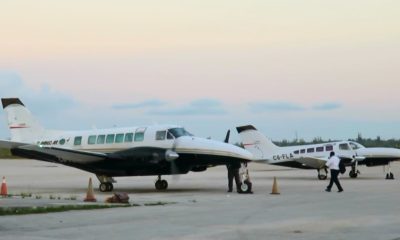
The Cessna 402, operated by Flamingo Air and registered as C6-FLX, went down in a heavily wooded area near the San Andros Airport.
Since then, many have been asking: What happened in those final moments?
Over the weekend, the Aircraft Accident Investigation Authority released its preliminary findings, offering the first detailed account of the flight and the crash.
And here’s what investigators have found so far.
When it comes to the flight itself, the report states the aircraft had completed three flights that day. Two were successful round-trip flights from New Providence to Andros.
The third flight, an outbound flight to Andros that departed around 12:30 p.m., ended fatally. Prior to that final flight, the aircraft had taken on 60 gallons of fuel that day.
At 12:43 p.m., the aircraft made a slight right turn to the northwest, a maneuver the report says was consistent with joining a traffic pattern for Runway 12 on its approach to the San Andros Airport.
Radar data showed the aircraft at an altitude of approximately 2,500 feet at that time.
But about three minutes later, at approximately 12:46 p.m., the aircraft made a left turn consistent with following traffic-pattern procedures as it prepared to land at the airport.
At that point, radar data showed the aircraft descending from approximately 1,800 feet on its approach to land at San Andros Airport.
During the final radar data recorded, the aircraft was at an altitude of approximately 300 feet, with an indicated airspeed of 62 knots, at about 12:48 p.m.
During that final approach, the aircraft impacted a stand of tall pine trees in a heavily wooded area, with the aircraft’s left wing making initial contact with the trees.
The report further notes that, after that initial contact, the aircraft’s forward motion continued as it made further contact at the mid and lower levels of a stand of pine trees.
Investigators also found evidence of fire and associated damage to the surrounding environment, including charred tree bark and brown-colored foliage on the tops of trees.
The aircraft’s left-wing navigation light was identified as the furthest piece of debris.
According to the report, the distribution of the debris and the damage pattern are consistent with a low-velocity, low-angle impact.
When it comes to the aircraft itself, the report states that the plane was engulfed in flames after impact, destroying the central portion of the aircraft.
The left engine was damaged by a combination of fire and impact forces, while the left propeller remained attached to the propeller hub, with minimal signs of impact damage to its three blades.
The right engine, however, was extensively damaged by a combination of fire and impact forces.
The right propeller also remained attached to the propeller hub, but showed substantial signs of impact damage to all three blades.
All three right propeller blades were observed to be twisted and bent.
All of this damage can be seen in footage captured by Our News on the ground at the crash site.
The aircraft was piloted by Franklyn Cambridge. According to the report, Cambridge held a commercial pilot certificate issued by the Civil Aviation Authority. He also held airplane single-engine, multi-engine and instrument ratings, with a total of 13,000 hours of flight time.
And finally, when it comes to the aircraft’s equipment, the report notes that the plane was not equipped with either a flight data recorder, or FDR, or a cockpit voice recorder, or CVR.
However, the report notes that neither recorder was required by the relevant aviation regulations.







Meta to Pay New Mexico $25B for Deceiving Users About Privacy on Facebook

Guyana to Ban Recreational Vape Imports Amid Concerns Over Youth Use

Africa CDC Calls an Ebola Crisis Summit as Nigeria Records Its First Case

Man On Bail for 2021 Murder Denied Bail in New Shooting Case
Bahamian Murder Accused Won’t Serve More U.S. Jail Time Over Gun Case

The Bahamas Culinary & Arts Festival Receives Boost From Multi-Year Scotiabank Partnership
Former Credit Union Clerk Accused Of Stealing $1.2 Million
Church Fights For $300K Inheritance
Man On Bail for 2021 Murder Denied Bail in New Shooting Case
Prosecutors Seek Third Attempt To Try 2013 Airport Cocaine Case
Bahamian Murder Accused Won’t Serve More U.S. Jail Time Over Gun Case
Sexual Assault Claim Ends In Acquittal

From Panama to Saudi Arabia: MOFA Checks on Bahamians Amid Overseas Crises

Lincoln Blvd Shooting Leaves Man In His Mid-30s Dead

22 Bahamian Healthcare Professionals To Travel To China For Training

B.E.S.T. Foundation Launch Raises $500K In Pledges, Partners Needed To Support Education

FNM To Hold Closed-Door Post-Election Review Amid Leadership Questions

FNM Leader: Grand Bahamians Don’t Need to Be Gaslit

-
 Court2 days ago
Former Credit Union Clerk Accused Of Stealing $1.2 Million
-
National1 day ago
Church Fights For $300K Inheritance
-
Court11 hours ago
Man On Bail for 2021 Murder Denied Bail in New Shooting Case
-
Court1 day ago
Prosecutors Seek Third Attempt To Try 2013 Airport Cocaine Case
-
Court11 hours ago
Bahamian Murder Accused Won’t Serve More U.S. Jail Time Over Gun Case
-
Court3 days ago
Sexual Assault Claim Ends In Acquittal
-
 Lifestyle12 hours ago
The Bahamas Culinary & Arts Festival Receives Boost From Multi-Year Scotiabank Partnership
-

 Regional1 day ago
Guyana President Backs Death Penalty for Heinous Crimes After Boy’s Killing